
 100% Secure Payments
Commercial and
industrial HVLS fans
Find the right industrial or commercial fan to get the most out of your facility.

What Is an HVLS Fan?
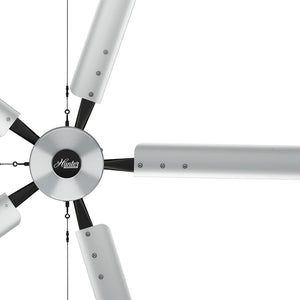
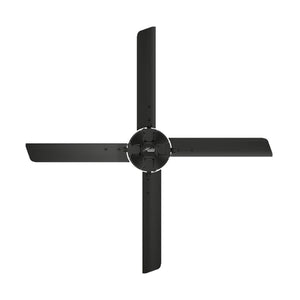
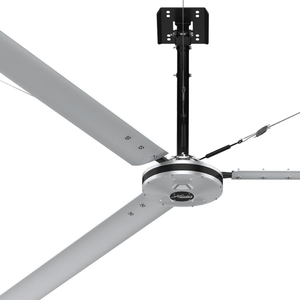
An HVLS (High-Volume, Low-Speed) fan is a large industrial ceiling fan, 7 to 24 feet in diameter, designed to move massive volumes of air at a low rotational speed. The gentle air movement these fans create mimics a natural breeze, helping to reduce the perceived temperature in a space in summer through the perceived cooling effect. In winter, running the fan in reverse pushes warm air that has stratified near the ceiling back down to the occupied zone.
HVLS fans help distribute airflow evenly across the full coverage area. One Hunter Industrial HVLS fan can potentially replace dozens of smaller traditional fans while consuming a fraction of the energy.
| Diameter range | 7 to 24 feet |
| Coverage area | Up to 22,500 sq ft with a single fan |
| Sound level | Under 55 dBA |
| Motor type | Direct Drive Motor. No gearbox, no oil changes. |
| Certifications | ETL to ANSI/UL 507 (all models). See certifications section for model-specific certs. |
| Manufacturing | Smyrna, TN |
| Warranty | Titan, ECO, and XP have the Limited Lifetime Warranty |
HVLS fans support ASHRAE Standard 55 compliance by maintaining thermal comfort in large, conditioned spaces without increasing HVAC load.

Where HVLS Fans Are Used
Hunter Industrial HVLS fans perform across the full range of large commercial and industrial environments. Each application below links to a dedicated resource.
- Warehouses and distribution centers: Help reduce heat stress, improve worker productivity, support comfort year-round.
- Manufacturing and production facilities: Assist in controlling temperature stratification in tall bays, manage humidity, improve air quality throughout the shift.
- Aircraft hangars: Handle large open volumes with no ceiling height obstruction. Effective year-round.
- Agricultural buildings and livestock facilities: Help reduce animal heat stress, control airborne pathogens, lower mortality rates in poultry and livestock operations.
- Automotive service and repair shops: Help manage heat in work bays, dilute fumes, improve technician comfort without disrupting vehicle work.
- Gyms and fitness centers: Maintain occupant comfort during high-exertion activity. Under-55-dBA operation does not interfere with classes or training.
- Breweries, wineries, and food processing: Direct Drive Motors means no oil. Food-safe eligibility without the gearbox maintenance risk.
- Event venues and large retail spaces: Whisper-quiet climate control without HVAC overload. Guests and shoppers experience airflow without drafts.
HVLS Fans Work Year-Round
A common assumption is that HVLS fans are a summer purchase. They are not. The return on a Hunter HVLS fan spans all 12 months.
Summer Airflow
Running at low speed in a counterclockwise direction, HVLS fans create up to a 10 degree perceived cooling effect without lowering the actual air temperature. Facilities can reduce HVAC runtime and operating costs while maintaining worker comfort standards.
Winter destratification
Warm air rises and stratifies at the ceiling in cold weather, sometimes 10 to 20 degrees warmer at ceiling height than at the occupied zone. Running HVLS fans in slow clockwise reverse pushes that warm air back down without creating a draft.

Built to Industrial Standards
Hunter Industrial HVLS fans are designed and tested to meet the certification requirements that commercial and industrial buyers need for facility compliance, insurance requirements, and procurement approval.
- ETL Listed to ANSI/UL 507: All models. Safety certification required for most commercial installations.
- CSA C22.2 No. 113: Titan, ECO, and XP. Canadian electrical standard for HVLS deployments.
- AMCA Certified*: Our Titan, ECO, and XP HVLS fans are AMCA certified*. Airflow performance independently verified by the Air Movement and Control Association. *AMCA Certification excludes XP 7' and DDI.
- NFPA 13 and 72 Compliant†: All Hunter Industrial HVLS fans. Fire suppression and alarm system compatibility for warehouses and manufacturing facilities.
- IP66 Fan Drive Enclosure: Available across the Hunter HVLS line for challenging environments
- IEC 61800-3 and CE†: All Hunter Industrial HVLS fans. International electrical standard and European market compliance.
CAD files, dimensional drawings, and full specification sheets are available for all models. Visit the individual product pages for downloads or contact us directly.
†NFPA and IEC/CE compliance excludes DDI.
Frequently Asked Questions About HVLS Fans
What does HVLS stand for?
HVLS stands for High-Volume, Low-Speed. The name describes the core operating principle: a very large fan blade span moves an enormous volume of air per rotation while spinning slowly enough that the airflow feels like a gentle, natural breeze rather than a forced draft. The category was developed in the 1990s specifically for large industrial and commercial spaces where traditional high-speed fans could not provide adequate coverage or comfort.
How big do HVLS fans get?
Commercial HVLS fans range from 7 to 24 feet in diameter. Hunter Industrial offers models from 7 feet through 24 feet. Fan diameter is selected based on the square footage of the coverage area and the ceiling height of the facility.
What is the coverage area of an HVLS fan?
Coverage area scales with fan diameter and ceiling height. At the high end, a single 24-foot Titan HVLS fan covers up to 22,500 square feet. Smaller models can cover 7,700 to 13,000 square feet depending on size and ceiling configuration. See the sizing guide above for diameter recommendations by space size and ceiling height.
How do HVLS fans work in winter?
In winter, HVLS fans can run in reverse at the lowest speed setting. Warm air that has stratified at the ceiling, often 10 to 20 degrees warmer than at floor level, is gently pushed back down to the occupied zone without creating a noticeable draft.
What is the difference between direct drive and gear drive HVLS fans?
Direct Drive Motor fans are connected directly to the fan blade hub with no gearbox and no oil required. Gear drive fans use a gearbox to translate motor speed to blade speed, which requires oil changes, produces more noise, and introduces a potential oil contamination risk. All Hunter Industrial HVLS fans are Direct Drive Motors. This means lower maintenance cost, whisper-quiet operation (under 55 dBA), and food-safe eligibility in processing environments where oil contamination is a disqualifying factor.
How much does an HVLS fan cost?
Commercial and industrial HVLS fans are specified for permanent installation in large facilities and priced accordingly. Cost varies by fan diameter, model, mounting configuration, and control options.
Contact us for a quote specific to your facility size, model requirements, and quantity.
What ceiling height do I need for an HVLS fan?
The minimum recommended ceiling height for HVLS fan installation is 10 feet above the finished floor.
What HVLS fan certifications should I look for?
For most commercial and industrial applications, look for ETL listing to ANSI/UL 507 (the primary US safety standard), AMCA certification* for independently verified airflow performance (*AMCA Certification excludes XP 7' and DDI), and NFPA 13/72 compliance if your facility has an active fire suppression system. For covered outdoor locations or challenging environments, IP66 rated drive enclosures are required.
How many HVLS fans do I need for my facility?
Fan quantity depends on total square footage, ceiling height, obstructions (racking, mezzanines, overhead equipment), and application requirements. A single 24-foot Titan covers up to 22,500 square feet in an open, unobstructed space. Facilities with racking or partial obstructions may need additional units. Contact us for a no-cost fan assessment and we will calculate the right quantity and placement for your specific floor plan.
Are Hunter HVLS fans suitable for outdoor or wet locations?
With an IP66-rated Fan Drive Enclosure is designed for covered outdoor applications. The IP66 enclosure provides protection against water ingress from any direction. Contact us to confirm the right configuration for your specific environment.
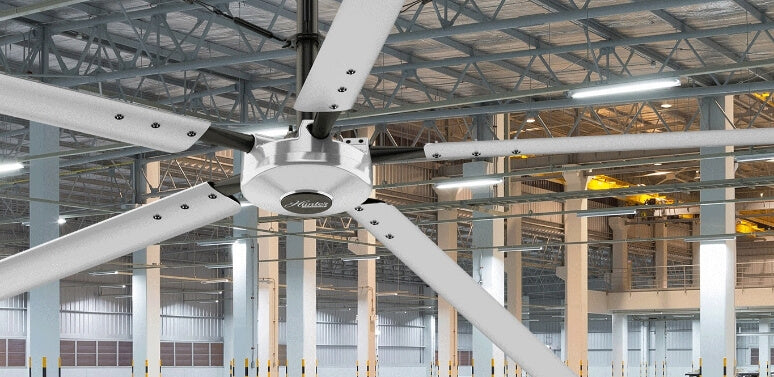 Top 5 Benefits of HVLS Fans for Warehouses
Discover the top five benefits of HVLS fans for warehouses, from improved airflow and comfort to greater energy efficiency and lower cooling costs.
 How to Install an HVLS Ceiling Fan: Industrial Fan Installation Guide
Learn how to properly install an HVLS ceiling fan with this practical guide covering key steps for safe, efficient industrial fan installation.
 HVLS Destratification: How HVLS Fans Improve Comfort and Reduce Energy Costs
Discover how HVLS fans use destratification to improve indoor comfort, balance temperatures, and reduce energy costs in large spaces.